
An Island In the Sky
Asmara, Eritrea, Ethiopia 1959 thru 1962
By John Dennis Hannigan 1-21-2011
Introduction
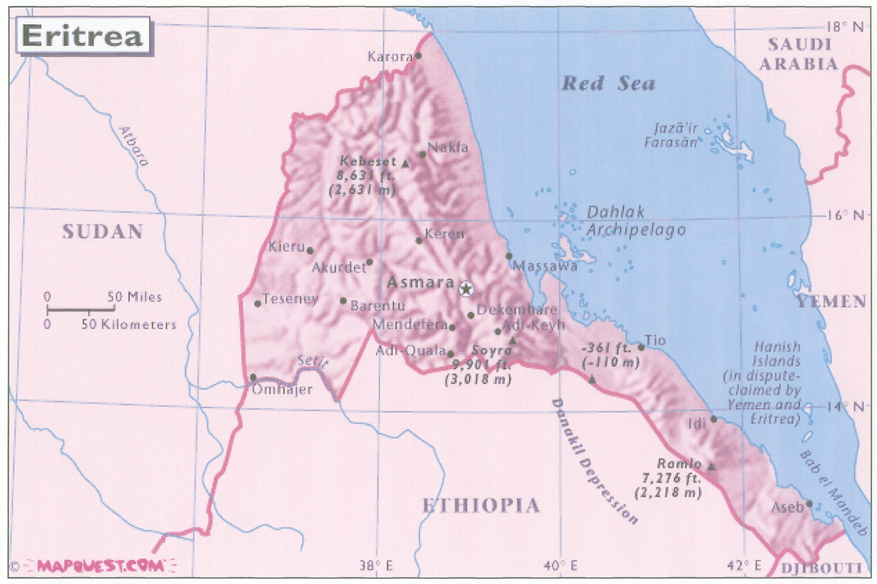
The following is a summary of personal events when my family and I lived for over three years on the East Coast of Africa in the county of Eritrea under United Nations control of Ethiopia, and his Imperial Majesty Haile Selassie. My family and I arrived in Asmara in August 1959 and returned to the United States in October 1962. As I write this in 2006, forty-two years after I returned to the United States, Eritrea is now an independent Nation under its own political system with defined boarders with other African Nations.
I was in Asmara on a military assignment to the U. S. Armed Forces Kagnew Station Communication Site outside of the city of Asmara. This book will not elaborate on my military assignment but will share the enjoyment that my family and I found living in a Foreign Country. We found the East Coast of Africa, and specifically all the Eritrean cities, towns, and villages, as well as, the Capitol City of Asmara, an island in the sky, to be educational, intriguing, and interesting, and a memory that I will never forget living on that mountain top.
We found the country of Eritrea to be rich in history going back many centuries, especially during the Second World War, when it was occupied by the Italian Occupational Government and their German allies. Like the whole of northern Africa from 1938 thru 1944, Eritrea played a major part in the Second World War because of their Red Sea seaport in the City of Massawa.
The Italian Occupational Government developed most of the roads systems, train system, airport, and cargo lift system that run from the Port of Massawa to the top of the mountain in Asmara during the Second World War, as well as, other major cities for Eritrea. The road system was built for driving on the right side of the road during the Italian and German occupation.
The train system still was active during my visit and probably is still active in 2006 making daily runs to the east including the cities of from Asmara to Dekemhare and Massawa, as well as, daily runs to the north from Asmara to the cities of Keren, Akurdet, Kebeset, and Nefka.
After World Ward II the British Military and their Government Officials also occupied Eritrea as part of the United Nations agreement and influenced some of the culture in the Eritrean communities. They incorporated driving on the left side of the road just as they did in England. It was an experience to get used of this coming from America where we drive on the right side of the road. Today the Independent Country of Eritrean probably still drives on the left side of the road a carry over from the British. Then the United Nations in 1946 turn the occupation over to the neighboring Country of Ethiopia which was known as Abyssinia prior to World War II.
An interesting point is that the Abyssinians and Eritrean’s Calendar stopped when the Italians took over in the late 1930’s and started up once again when The Eritrean’s returned and attacked the Italian Outpost at Keren with knives, spears and axes. They won back the city of Keren and then moved up the mountain to the Capitol City of Asmara and restored the Eritrean Government.
.
It is my understanding that The US Army Security Agency sent the first contingent to Asmara, Eritrea in the late 1940’s. This contingency set up operations on the Italian Old Radio Marina Site and lived in tents. Eventually, the Old Radio Marina Site grew to Kagnew Station in the early 1950’s. Kagnew Station American Community grew for assigned single and married military personnel and their dependents from the middle 1950’s through 1974 when Kagnew Station was closed as a result of the Eritrean independence from Ethiopian.
We had two children, a boy and a girl, born at the U.S. Army Hospital on Kagnew Station. They have dual citizenship being born of American Citizens in a Foreign Country, as they are Citizens of the United States as their U.S. State Department birth certificates verify. It is not sure if they had either an Ethiopian citizenship or an Eritrea citizenship as they were born in Eritrea but under the control of Ethiopia Occupational Government.
The game of golf was an exciting experience in Asmara. The course was 18 holes of rough terrain with sand greens. The greens were coated with a light coat of oil to prevent the sand from blowing away. Once on the Green, a player would leave a ball mark and trail as the ball rolled toward the cup. After each hole, the green would have to be raked for the next group of players. Thereby, the green contour changed after every group left the green. It was a challenge as one never knew what the next greens contour would be from one day to the next.
This book is a list composite of short stories or events that I remember of the time that I spent in the country of Eritrea some forty years ago. This book is taken from original letters, notes, and pictures taken by myself and my family.
I have tried to keep the stories in some sort of sequence in relationship to certain locations. For example, any event that took place in Asmara, Keren, and Massawa are together. It doesn’t mean that these event or short stories took place in succession as written.
OUR FAMILY’S LONG JOURNEY
BY
JOHN D. HANNIGAN July 29th, 1959
Flight from McGuire AFB, New Jersey to Asmara, Eritrea, Ethiopia
As your mother wrote in earlier 1959 letters home, the family arrived at McGuire AFB, New Jersey on July 29th and was booked on a Military Aircraft Transportation Services [MATS] military aircraft with a destination of Rhine-Main AFB, Germany. Our family boarded the plane it was like a commercial aircraft except the seats face to the rear of the plane. After settling in to our seating arrangement, John sat with me and Cathy sat with mother. A Women Air Force [WAF], serving as a stewardess, took our luggage and stowed it. The plane was full of personnel going to Thule AFB, Greenland and Rhine-Main AFB, Germany. We left McGuire AFB about seven o’clock in the evening, with our first destination Thule AFB, Greenland.
Once airborne, the WAF brought us box lunches and blankets. After supper, John and Cathy fell asleep and your mother did a little later. I was wide awake when we landed at Thule AFB, Greenland in the middle of the night. The passengers unloaded and went inside while the airplane refueled for the next leg of its trip. It was cold in July compared to the Untied States.
After about an hour all the passengers for the final flight to Rhine-Main AFB, load up and the plane took off. We all got back to sleep and awoke after landing in Germany.
I checked in with military processing and showed them my orders for Ethiopia. We were assigned a room at Frankfurt Main Airport, Germany to await a flight to Ethiopia.
We all had to go to the dispensary to get the last batch of shots before leaving Germany. Your mother was pregnant with David Brian and she had to see the OB-GYN Doctor for clearance to fly. While at the Hospital she was exposed to German measles. We all had to go back the next day and get a gamma globin shot to prevent us from coming down with the German measles also protecting your mother’s pregnancy. This caused a three to five-day delay until we received medical clearance.
Meanwhile, we were restricted pretty much to our room at the airport. Only time we could leave was to either go to the dispensary, hospital, or eat. Our room shared a bath with the next room. One day one of us had to use the bathroom. The door was locked on our side. I went next door and knocked but got no answer. I saw a German maid and tried to converse with her. Finally, she followed me to our room to see what was wrong. She still didn’t understand. I went to the bathroom door and said ‘Caput”. I finally got thru to her and she unlocked the bathroom door.
When we received our medical clearance, we received our flight instructions from military processing. We were booked on Ethiopian Airlines flight from Frankfurt-Main, Germany airport to the Asmara, Eritrea, Ethiopia airport. Once on board and settled we took off with our first stop being Rome, Italy. We remained on the plane at Rome. The next stop was Athens, Greece. We circled Athens, we saw what a beautiful city it was. Our next stop was Cairo, Egypt. We landed in Cairo early in the morning. Mother and both you children were fast asleep. I decided to get off and go inside the terminal and have a cup of Arabic Coffee. As I deplaned, I notice a Large Russian Aircraft next to our Ethiopian Airplane. Russian soldiers stood guard with AK47’s every fifteen feet. I left my military jacket on the plane and proceeded to the airport. Upon entering the airport, I received quite a bit of looks. Abdul Nasser was the Egyptian Leader at the time and he was not too friendly with America. I drank my coffee and headed back to the plane. I was stopped by Egyptian customs and my Military U.S. Passport was on the plane. Another Arab traveling on the Ethiopian plane spoke to the Customs Personnel and they let me return to the plane. After boarding the plane, I said ‘I hope I never land in Cairo again.
We left Cairo and our next stop was Asmara. You all were still asleep, so I tried to sleep. About forty-five minutes into the flight, the pilot came on the intercom and said we were returning to Cairo as one of the stewardesses [Greek] was sick and need to go to a hospital. Once again, we landed at Cairo and when they opened the passenger door of the plane a Red Crescent Ambulance pulled along side. The attendants stood there and talked to the Greek Stewardess but would not come up the ladder to pick up the injured stewardess. Finally, an Arabic Stewardess asked if someone could help the Greek stewardess to the ambulance. Another man and I made a chair with our arms and lifted the Greek stewardess down the ladder and put her in the ambulance. The ambulance left and the plane resumed its flight to Asmara. The Arabic stewardess told us that the Egyptians wouldn’t touch the Greek because she was Christian and against their Muslim religion.
We arrived in Asmara, Eritrea, Ethiopia the following morning. We deplaned and went thru Ethiopian customs without a problem, got our baggage and met our sponsors for a ride to Kagnew Station. Upon reporting in to my next assignment, the first sergeant asked why I was wearing my dress military green uniform. He told me I was supposed to travel in civilian clothes because I was traveling thru countries that did not have much to do with Americans. He sent a message back to Germany military processing and made sure the next Americans coming into Kagnew Station were in civilian clothes.
WELCOME TO ERITREA, ETHIOPIA
BY
JOHN D. HANNIGAN July 30th, 1959
As the Ethiopian airliner flew southeast from Cairo, Egypt headed for Asmara, Eritrea, Ethiopia dawn came up in the east. Sitting on the left side of the aircraft, the country of Eritrea started to develop in my view. Eritrea’s high mountainous terrain and deep lush green valleys and ravines dropping off sharply to an arid desert that led to the Red Sea.
My mind raced as I began to wonder what this African country would be like for my family to live and me to work in for the next thirty months. I was in the U.S. Army and getting ready to report to my next duty station at Kagnew Station, Asmara. This was an accompanied tour of duty with my wife Joanne expecting another child in January 1960, son John, and daughter Cathy. Although there was a good size American community at Kagnew Station, what would it be like to live with native citizens of this country? Well we would soon find out.
The pilot came over the intercom system of the airplane and said that he may have to make a couple of low passes of the Asmara airport runway if the baboons were out. He went on to say that the baboons lived on top of the mountain and sometimes they would be on the runway and near the terminal. I thought wow, we haven’t even landed yet and there are wild game waiting for us. What a reception.
We landed and deplaned and went inside to terminal. We passed through Ethiopian customs with no problem and picked up our luggage. Our military sponsors, Herb and Barbara were waiting for us. We loaded up their car and headed for my next duty station.
AIRPORT ROAD TO ASMARA
BY
JOHN D. HANNIGAN JULY 30TH, 1959
Leaving the Asmara airport, we passed a military installation of the Ethiopian Army. It was much like any U.S. Army installation although a lot smaller. As we entered the airport road, Herb and Barbara was telling us about Kagnew Station and the city of Asmara. Herb drove on the left side of the road. He told us ‘we will have to get used to this as all traffic drives on the opposite side of the road than in the United States.” I believe this is a carryover from the British influence on the Eritrean communities after World War II.
As we passed the countryside, we saw a small village of Eritrean nationals doing their normal chores of the day. I noticed donkeys, cattle, but no baboons. Their housing was made of some type of mud and brick and has thatched roofs. The people seemed very friendly and some waved as we drove by. Further on the road, we notice the greenery of plants growing, palm trees, and other things that would make up another village.
One thing that really surprised us was that all the small children were either naked or just had a shirt on and no pants. Looking back on this, I guess that meant no dirty diapers to change for the parents to take care of. When you had to go to the bathroom, one just went wherever you were and moved on.
WELCOM TO ASMARA
BY
JOHN D. HANNIGAN JULY 30TH, 1959
As we approached the Capitol City of Asmara on our way to Kagnew Station, I was surprised to see how large it was and the activity going on in the city. I had thought that this would be simply a large village where Eritrean, Ethiopian, Italian, Americans, and other nationalities living amongst each other with their own section of the city.
Asmara is a modern city, paved streets, fluorescent lights for the main roads and the downtown shopping area. Palm trees lined the streets. Houses like those in the United States. No need for air conditioning as houses made of concrete. Beautiful Churches of different denominations. Herb told us that this was a Christian nation and not an Arab nation. Cars drove by on both sides of the street. The local taxi service was a horse drawn Gerry cart.
As we turned to go to Kagnew Station, there was an AGIP Shell Gas Station on our right with a big neon sign that advertised the gas station. The drive up the hill was about three o’clock in the afternoon to the main gate of Kagnew Station. The U. S. Army Military Police on duty waved Herb’s car through the main gate as we arrived at my duty station.
The coming months we got familiar with the Capitol City of Asmara, as well as, the country of Eritrea and surrounding countryside.
KAGNEW STATION
BY
JOHN D. HANNIGAN JULY 30TH, 1959
Herb and I entered the orderly room and I reported into the first sergeant. He looked at me and asked me why I was wearing my Military uniform. I answered him “I was traveling on military orders”. When he checked my orders, he found that my processing center has left off that I should travel in civilian clothes.
I signed in and then was release for a few days to get my family settled into quarters off post. The post guest house was full, so my family settled into a hotel in downtown Asmara. The accommodations were not like we were used to in America, but it was certainly adequate for a few days until quarters were available at Kagnew Station.
While living downtown and getting settled into our new community for the next thirty odd months, my family became familiar with the capitol city of Asmara. It was like any compatible American city with business area, hotels, city and governmental buildings, movie theatres. The people were friendly and were eager to see Americans. This gave us a good sign of security that we had not expected.
Outside of the business area was the Bosch. The Bosch is the native portion of town where they come to sell and buy commodities that are needed for their villages and homes. Some of the local inhabitant lived in the Bosch.
The few days in the hotel also gave us time to search for a residence off post as I was not able to get post housing. We looked at several homes that were within walking distance of the Base bus stops, so that the family could travel back and forth without too much walking.
Within a few days, we were told that quarters for us were available in the Kagnew Station Guesthouse for the next week. After finding a house that we liked, we moved off-post Coordinated with Quartermaster for furniture until ours arrived from the States, I went to my duty station and my family stayed at the Kagnew Station Guesthouse.
Besides our sponsors, Herb and Barbara, we had friends there that we met when I was at the U. S. Army Signal School, Fort Monmouth, NJ. Arvid and Renita were at Kagnew Station for almost a year. We were fortunate to have the availability of two families that could help us get settled in at Kagnew Station.
One of the first things we learned was to go to the American Finance and exchange American dollars to Ethiopian dollars for use in purchasing anything off post. The legal exchange was one American Dollar [$1.00] equaled two dollars and fifty cents [$2.50] in Ethiopian currency. The next thing we learned was that there were three values of money on the local economy. They were local native population, which included Eritrean and Ethiopian personnel, Italian personnel, and American personnel. Bartering or dickering on the price always helped.
Moving into our home was different for us since we always lived in an apartment in America. The home we chose was a large Eritrean owned home with marble floors and eight-foot ceilings. We had five rooms with a bathroom and a flat roof which held the water for the bath and the kitchen. The Quartermaster moved in enough furniture for us to function as a family until our furniture arrived from America.
There was a garage and maid quarters also on the property. A six-foot high cement wall enclosed the yard. On top of the wall was broken glass embedded in the cement to hinder any Clifties entering over the wall. A Clifty is a house bandit. The house and surrounding yard was very, very comfortable for us. Less than a block away was the back gate to the Old Radio Marina site where I got the Post bus every morning to take me to work.
PUBLIC HANGINGS IN ASMARA, ERITREA
BY
JOHN D. HANNIGAN AUGUST 3RD 1959
A few days after arriving in Asmara and while I was still processing into my assignment at Kagnew Station, my family and I visited the Bosch in downtown Asmara.
This one day as we entered the Bosch, we notice that there were three gallows sitting in the middle of the Bosch. We were curious as to why there was gallows for public viewing.
From the direction of the Ethiopian Prison up on the hill came the beat of a drum. Soldiers marched leading prisoners down the hill and into the Bosch public square. The closer they came the easier it was to identify the prisoners. To our amazement, the prisoners were three women.
As the column of army troops and the prisoners entered the square, the local people moved back and trading was just about stopped at the market area.
Each woman was left by each gallows. They were led up the steps and a rope was placed around their neck. An official was reading something in either Ethiopian or the Amharic, language, stating what the women had done. We found out later that these women had infected some Ethiopian soldiers with a venereal disease and therefore they were condemned to die by hanging. We left the Bosch thinking how cruel this was.
As we learned more about the Judicial System in Asmara. We found out that thieves lost a knuckle on their left hand every time they were caught stealing. If the were a habitual thief and lost two-fingers, then the next time they had their hand cut off. This type of judicial punishment told the locals that if you commit a crime this could happen to you. These disfigured people on the streets emphasized to other local inhabitants that it was not worth committing a crime against the judicial system or the occupation of the Ethiopian Government and Military.
DEATH OF THE EMPERESS
BY
JOHN D. HANNIGAN 1960
One morning, I was preparing to go to work, my house girl Hairgo told me Her Majesty the Empress of Ethiopia had died. As Head of State, this meant that the nation of Ethiopia would declare an official mourning period in memory of the Empress.
When I reach Kagnew Station, her death was verified by the post commander and we began a thirty-day mourning period for Her Majesty. Work continued at Kagnew Station as on any other normal day. The major impact to Kagnew Station was that Armed Forces Radio and Television Station {AFRTS} KANU would not broadcast any radio or television programs for the thirty-day period. All other Kagnew Station recreation activities still functioned as usual.
The city of Asmara, Eritrea was also bound by the thirty-day official mourning period because of the Ethiopian Occupational Government. Most public businesses closed such as the movie theatre, restaurants, and bars. The Bosch and downtown businesses continued to be open on a reduced schedule of operating hours. The Second Ethiopian Division Military stationed in Asmara was also on alert. Asmara day and night life almost came to a standstill. Other cities, towns, and villages within the country borders of Eritrea also honored the Ethiopian office mourning period.
When the thirty-day official mourning period ended, the city of Asmara, Eritrea returned to its normal activity. KANU operated once again bringing radio and television programming to the American Community at Kagnew Station.
OVETHROW OF HIS IMPERIAL MAJESTY
BY
JOHN D. HANNIGAN 1960
While abroad on a diplomatic mission, His Imperial Majesty Emperor Haile Selassie Government was overthrown in the Capitol City of Addis Ababa, Ethiopia by a rebel regime. The First Ethiopian Military Division stationed at the Imperial Palace stayed loyal to the Emperor as did the Second Ethiopian Division stationed in the Capitol City of Asmara, Eritrea.
The Emperor returned to claim his Throne by way of Asmara and visited the American Base of Kagnew Station. His personal pilot an American named Tex Salyers landed the Emperor’s plane at Asmara airport under heavy Ethiopian Military guard. After deplaning at the Asmara airport, His Imperial Majesty rode into the Capitol City of Asmara under Ethiopian Military guard. The local people cheered as he rode by on his way to Kagnew Station. Upon arrival at Kagnew Station, he was greeted by Lt. Col. Harris, Post Commander, and then reviewed an American Military Honor Guard in his Honor.
Later, he flew onto his Capitol City of Addis Ababa, Ethiopia and regained control of his government and returned to his Throne as the Imperial Majesty. Once regaining control of his government, he had the rebel leaders put in prison and set for trial. The trial concluded with the public hanging of the rebel leaders.
Most western newspaper and magazines covered the overthrow of His Imperial Majesty as a major world event and pictures and stories of the public hangings appear in all major magazines in the western world. His Imperial Majesty banned these publications within the Ethiopian borders, since he didn’t want the Eritrean and Ethiopian population to know what the end of the rebel regime was.
These publications could not be made available to Americans at Kagnew Station through the PX or copies from the Untied States. Stateside family members writing to Kagnew Station personnel about the happenings in Addis Ababa, was the only way that we received the news.
The second Ethiopian Division stayed loyal to the Emperor, and also to the Kagnew Station Post Commander, Lt. Col. Harris during the rebel regime government overthrow in Addis Ababa.
FIRST TRIP TO MASSAWA, ERITREA
BY
JOHN D. HANNIGAN 1960
I received word from the Transportation Office that my automobile has arrived from the United States and was available for pickup at the Port of Massawa, Eritrea on the Red Sea. This was interesting since I was living in Asmara approximately 7800 feet above sea level and naturally the Port of Massawa was at sea level. By now my family and I had become adjusted to the high altitude and the ride down the mountain some 70 miles to Massawa would be quite a change for me.
I arranged with Arvid Erb, my friend from Fort Monmouth, New Jersey in 1957, to go down on Saturday to pick up my automobile. We left Asmara in his Volkswagen Beetle about seven o’clock in the morning. It would be my first experience of descending the mountain on the left side of the road. Arvid told me that the road was marked off in kilometers and had many curves that we were going to be basically traveling east although the road would mak1 many turns on the descent.
At about the three kilometers mark, we passed the British Military Cemetery with the Flag of England flying. About another kilometer, we passed a local village of similar homes to those I seen on the way into Kagnew from the airport. Arvid slowed at the seven-kilometer mile marker to point out the city dump and baboon mountain. He told me sometimes the baboons are on the road and sometimes they throw things at the vehicles as they pass.
Further down the road, I noticed a line of cables and cars that ran up the mountain. Arvid told me they were used to bring cargo up from the Massawa to Asmara. They were built by the Italian Army during the occupation of Eritrea from 1938 to 1944. He also told me that the mountain road was constructed by the Italian Army Engineers during that period.
A few more kilometers and I noticed an airstrip that was about twenty kilometers from Asmara. This belonged to the United States Consulate in Asmara. From there we descended into the town of Dekemhare. This was smaller than Asmara but was the first major bus stop on the way to Massawa for the local population. An interesting point about Dekemhare is that on top of the mountain overlooking the town was a Coptic Christian Monastery where the high priest and the monks lived. No one could visit the monastery as the only was up that mountain was by a rope elevator. The elevator was always on top of the mountain unless in use by the high priest or the monks. In the town of Dekemhare, I noticed a train station and was told that it was for the Littorina Train that ran between Asmara and Massawa. There was another train that ran between Asmara and Keren.
Further down the road we went through another village and then came to stop at the halfway point. The halfway house was a restaurant of African décor and owned by an American who has served at Kagnew Station earlier. He married an Italian lady and decided to spend his life in Eritrea. His name was Jesse. After having a cool beer and resting awhile, we left and continued my first trip to Massawa. The half-way house was about at the end of the mountain road. The road straightened out a little as we descended to the desert floor. When we hit the desert floor it was about eight thirty in the morning and the temperature was already hitting above one hundred and ten degrees. We rolled across the desert floor at a good speed heading east to the Port of Massawa. To my amazement although it was that hot, there were natives and Nomad tribes walking their herds of goats and camels across the desert floor towards Massawa.
Before entering the town of Massawa, I noticed a large building off to the northeast. On a subsequent trip down the mountain, I learned that the building was built by the Italian Occupational Government to produce brick and cement. Soon, I saw people working in the desert [similar to an America would be a cranberry bog]. Arvid told me that they were making salt and cutting it into slabs to put on a camel train for transportation someplace else.
Massawa was the major seaport for Eritrea. The town was like any of the two cities I had now seen, Asmara and Dekemhare. First, we stopped at the United States Rest and Relaxation Center and had another beer. The temperature was now one hundred and thirty degrees. We sweated out the beer quickly. We then drove thru the major part of the city of Massawa to get to the Port, so I could pick up my automobile in Ethiopian Customs. When we arrived at the Port, we were told that my automobile had not cleared Ethiopian Customs and would not be available until Monday. We went back thru town to the R&R Center and had something to eat and a few more beers before starting on a return trip up the mountain.
The return trip up the mountain was just exciting. As we went up the mountain road, the temperature cooled down. We stopped at the halfway house and had another beer before starting the climb to Asmara. The only concern I had going back was that we were driving on the left side of the road and the ravines and valleys were a long way down if we went off the road.
We made the same trip on Monday and I picked up my automobile. I followed Arvid up the mountain road, which was the first time I drove on the left side of the road. What an experience. During our stay in Eritrea, my family and I made the Massawa trip several times a year.
BABOON MOUNTAIN
BY
JOHN D. HANNIGAN 1960
One Sunday afternoon, my family went for our first ride in our automobile out the Massawa Road to Baboon Mountain. It was our first venture out to get accustom to driving on the left side of the road. Baboon Mountain was about the seven-kilometer marker on the road to Massawa.
As we passed the city dump, we noticed a road leading down the mountain and into a valley. We decided to see where it led us. The down hill grade was steep and winding but flattened out about a kilometer down to a dirt road. As we drove thru the valley, we saw several Baboon families. The valley floor was green. We came upon a Plantation with banana trees and other fruit trees, as well as, vegetables growing. It was surprising to see this farm flourishing just below the city dump. We never did get to the end of the dirt road or see the main property of the Plantation.
Turning around, we backtracked to the Massawa Road and on to see Baboon Mountain. This mountain was on the top part of another mountain that rose between fifty to seventy feet above the Massawa Road. This hill was covered with hundreds of Baboons from little babies to full grown ones. The baboons evidently had claimed this part of the mountain due to the city dump being less than a kilometer away. The city dump provided plenty of food for the baboons. In addition, the Plantation being about a kilometer below the city dump which provided additional food for their families.
My family was quite happy to stay in the automobile and look at the baboons scurrying over the mountain top. It was the first game animals that my family seen in Africa. They were just as curious of us as we were of them.
ROAD BANDITS
BY
JOHN D. HANNIGAN 1960
A short time after arriving at Kagnew Station, we were told about the Road Bandits, Shiftas, as the natives called them. The Shiftas are a rebel group that erects barricades on the roads and hold up people.
Of the three cases I heard of they all happened on the Asmara to Massawa Road.
The first case involved U.S. Military coming back from Massawa after picking up the U.S. Mail from the Port of Massawa. I understand that it took place about the twenty-kilometer mark of the road just above Dekamhare. As the military vehicle rounded a curve there was a roadblock. They had to stop and that is when the Shiftas tried to hold them up. The Military engaged in a gun fight with the Shitfas bandits. The results were tall the Shiftas were killed. The American surprised the Shiftas and fired before the Shiftas could. United States Military Police and Ethiopian Police called to the crime scene. After investigation was complete the U.S. Military personnel and their vehicle proceeded to Kagnew Station.
After hearing this first story about the Shiftas, we never left the mountain without carrying firearms for our personal protection. I purchase a pair of Beretta Pistols for my wife and I, and I also carried at a Berretta Shotgun with deer slugs loaded just in case we came across any Shiftas.
The second case involved an Italian Truck Driver that was my neighbor, when we lived off-post. Once again, he was returning from the Port of Massawa with provisions for the City of Asmara and the merchants. He was attacked on the desert floor just before starting up the mountain. The Shiftas stopped his truck and ordered him out of the truck. To save his life he told us that he gave them all the money that he had. They left his truck alone but shot him in both kneecaps and left him to bleed to death. Fortunately for him another vehicle came along and helped him and got him to a medical facility. The Shiftas were never caught for this holdup. After full recovery, he continued to drive his truck as he did before down the mountain road between Asmara and Massawa. Being shot in both his knees, he walked very stiff legged.
The third case involved a U.S. family returning from a weekend in Massawa. The Shiftas stopped their car on the desert floor and ordered them out of their car. The Shiftas took their money and water and some of their clothes and left them on the desert floor to fend for themselves. After awhile a vehicle came by and the American family was taken back to Massawa to the Rest and Relaxation Center. The Shiftas were never found.
TRIP WEST OF ASMARA
BY
JOHN D. HANNIGAN SPRING 1961
One Sunday afternoon, Arvid, Renita, Joanne and I decide to go for an afternoon drive west of Asmara. We had never traveled that way and were sure that the ride would be interesting. We packed up a picnic of hotdogs, beans, refreshment, and desert. We left the children with our house girls Harigo and Helitie.
Since all the roads were paved, I decided to drive our American car which gave us a little more room for comfort on the road. As we headed west of the Asmara, we saw farms, natives with cattle, and donkeys. About thirty minutes down the road we saw a large village on another mountain top. The most prominent building was the Coptic Church and the village was built up around the church. Thinking back now, every village had a prominent Coptic Church in the center of the village no matter how large or how small.
We spotted a nice shady area by the side of the road and stopped to have our picnic. The flies were unbearable, but we decided to stay. Arvid and I broke out the charcoal and started a fire. Within ten minutes, we were descended upon by a group of villagers. Some were begging for food, others for money. An older man stepped forward and talked to the group. They settled down and left.
The man came over and tried to communicate with us. Arvid knew enough to tell him that we were going to eat. He motioned that he would cook for us, if we would give him the empty pop and beer cans. Arvid agreed. Now this was a real picnic, sitting in the shade and relaxing and having the man cook our hotdogs and heat up the beans. He even served each of us our meal on paper plates. He did not want to eat any of our food.
When we were through eating, he collected the paper plates and threw them on the charcoal fire. After they burned, we threw some water on the fire and made sure it was out. Then we gave the man about ten empty cans and he went on his way back to the village.
We cleaned up the area, loaded the car up with the leftovers from the picnic and drove back to Asmara.
ANOTHER TRIP TO MASSAWA
BY
JOHN D. HANNIGAN 1961
The four of us Arvid, Renita, Joanne, and I decided to take a short trip to Massawa over the weekend. We left our children with our house girls Harigo and Helitie on the mountain. Arvid took his Volkswagen and we left early Saturday morning. The drive was cool down the mountain. We stopped at the halfway house to relax and pickup some refreshment before continuing the decent down the mountain to the desert floor. The temperature was over one hundred degrees as we drove across the desert to the Rest and Relaxation Center in Massawa.
After getting some rest and cooling off, we went shopping in downtown Massawa. Upon returning to the Rest and Relaxation Center, we had lunch. What to do the rest of the day was the next question. We had already been to the beaches of the Red Sea, had toured the Port of Massawa and the City of Massawa. Arvid suggested that for a change we tour south of Massawa toward the town of Adi Keyh. We all agreed. We loaded up on water and beverages so off we went in the Volkswagen.
Heading south on the desert floor it was hot and the dirt road was adequate for the Volkswagen to maneuver the rough spots. We saw a camel train to the west and passed a couple of small villages. The people came out to see who we were and Arvid honked the horn as we drove by. Further down the road became less a road and more of a path. We saw a pack of wild dogs out on a hunt for food. The road conditions became worse and Arvid did not want to damage his Volkswagen, so we turned around and returned to Massawa. Unfortunately, we never did get to see the town and people of Adi Keyh.
MONEY FOR THE NATIVE POPULOUS
BY
JOHN D. HANNNIGAN 1961
After a few trips down the mountain to Massawa, I realized that the city of Dekamhare was more interesting that I first determined on my initial trip to Massawa.
On some earlier trips, we had noticed as we left Dekamhare going toward Massawa we drove though the native living areas. The people would come out to the street and beg. The children would cry ‘paunie’ which meant bread in their native Amharic language. Of course, in the eyes of these villagers, we were rich Americans and had lots of money to give to them.
My family was going to Massawa to spend a few days off the mountain and enjoy the Rest and Relaxation of the Red Sea beaches and downtown business area of Massawa. I made a special effort to go to the Base Finance to exchange some American Money for Ethiopian coins that we could give to these native children in Dekamhare. Most of the poor native population in Eritrea did not know what the Ethiopian Dollar meant, they only recognized Ethi0oian coins as something they could use to buy things.
As we got to Dekamhare, we stopped in the native residential part and I started to hand out some change to the children. In a few minutes, I had collected a mob of children and some adults. As the mob grew, I got into the automobile and as I started to drive away. The mob chased us down the road. I leaned out the driver’s window and threw the coins by this time now mostly pennies on the street. As I looked in the cars rear view mirror, the mob looked like a swarm of bees going after honey. I probably left about $5.00 Ethiopian coins on the street for a meer $2.00 American in the village for them to retrieve.
Returning to Asmara that evening, of course we had to drive thru Dekamhare to get home. As we approached the city, the native population came out and waved at us as we went by. It was their way of showing us that they were grateful for the money.
It was just one more little memory of Eritrea and the native people of Dekamhare.
ITALIAN BRICK COMPANY
BY
JOHN D. HANNIGAN 1961
On another trip to Massawa with a co-worker, we decided to explore a little of the desert floor area around Massawa. One of the interesting areas was located around the Italian Occupational Government Building that the Italians used to build brick and concrete during their occupation of Eritrea.
The remains of the building stood out on the horizon, so we decided to drive over to it. The closer we got to the building the larger it looked. It was interesting and educational to see how a building built in the late 1930s or early 1940s withstood the ever-changing weather and terrain of the surrounding desert floor.
The building was still sound and in good condition. It was unoccupied but we didn’t know how long. As we climbed to the top of the building, I was amazed at the view of the surrounding area and the Port City of Massawa. I am sure that the Italians may have used this also as a military installation observation post to view their enemy, the Eritrean populous, and allied forces during World War II.
We had an interesting time as we had our own private tour of this twentieth century landmark in the desert.
We did not notice any remains of items that we could call relics or souvenirs of that era, however touring this building showed that the Italian Engineers had built it to withstand not only, sand, wind and time, but to be a memorial the 1930 art of building construction.
GERMAN SUBMARINE BASE
BY
JOHN D. HANNIGAN 1961
On the same trip that we toured the Italian brick and concrete building, we also found reminisces a German Submarine Base near the Port of Massawa. This evidently was a supply base for the German submarines that controlled the passage of ships in the Red Sea and possibly thru the Suez Canal.
There were underground billets for the German Naval personnel that manned this base during World War II. There were channels for the subs to come in from the Red Sea to rearm, refuel, and pick up provisions for their next tour of duty under the Red Sea.
We walked thru the degrading facility as much as we could, hoping to find some World War II relics or memorabilia but to no success.
We also found out that this supply base was also connected to the Italian Brick factory by an underground tunnel.
Another interesting find was a German Fuel and Supply Dump in the desert for German General Rommel during World War II. A nomad tribe wandering the desert found this fuel and supply dump north west of the Port of Massawa. The Nomads notified the Ethiopian Army of their find. The Ethiopian Army unearthed the fuel and supply dump and most of the material was still in useable condition.
His Imperial Majesty Haile Selassie directed the Ethiopian Army to return the fuel and material to the country of Germany for their disposal.
NOMAD CARAVAN AT THE RED SEA
BY
JOHN D. HANNIGAN 1961
Living on an Island in the Sky on the east coast of Africa, is something I never thought our family would do. However, my military career took me there. Asmara, Eritrea was out home for 44 months, July 1959 – October 1962, during the Cold War. Asmara is the Capitol City of Eritrea which was put under United Nations Control in 1946 to Emperor Haile Selassie of Ethiopia. Asmara is located 5000 feet on a mountain top with narrow roads descending the mountain to the arid desert and the Port of Massawa 125 kilometers on the Red Sea. Average temperature was in the 70’s with two rainy seasons. The Eritreans were of the Caucasian race and decedents of the Queen of Sheba. Due to the altitude and close to the equator the skin had darkened
On one of our family trips with other families in Massawa area to spend some time relaxing, we chose to go to the Red Sea beaches just north of the Port of Massawa. There were three families, the Doyle’s, Erb’s, and Hannigan’s. The Asmara-Massawa road was opened from 7:00AM – 6:00PM because of rebels and road bandits.
The trip by automobile on the left side of the winding road with hairpin curves and tunnels thru mountains was rather treacherous. At the five-kilometer mark, we passed the city dump and at the eight-kilometer mark we were at Baboon Mountain. Hundreds of baboons roamed this mountain because of the city dump being close by. If they became angry with the traffic, they would throw stuff at the vehicles below. Next, we pass the State Department landing strip at the twentieth-kilometer mark. The landing strip was there for evacuation of military family personnel and other State Department personnel in case of a political problem.
Our first stop was Decamere, a city at twenty-eight kilometer’s mark known for the monastery on top of the mountain. The Coptic Christian priest and brothers lived there. The local people always waved and had their hand out for money for food. These people would not accept an Ethiopian Dollar bill but knew that the coins were good.
From Decamere the drive was just mountains and the temperature became warmer, thank goodness for air conditioned automobiles. We passed the halfway point and the temperature was in the 90’s. When we reached the desert, the temperature was in the mid hundreds. We drove across the desert and past the salt fields and turned left making our own road thru the sand headed for the beach
When we arrived at the beach area on Friday evening, the men set up the tents while the women took care of the children. They also dug some holes in the sand to be used as bathrooms for the adults and children. The temperature was well over one hundred degrees. Then, we set up the kitchen area for cooking and located a safe place for the charcoal fire away from the children. After settling down, we all changed into bathing suits which was the attire for the whole weekend and relaxed and swan in the Red Sea. The Red Sea is salt water. It is the main waterway between the Indian Ocean, thru the Suez Canal to the Mediterranean Sea. The water is not too choppy as ships of all nations pass North and South. The children played in the water and built sand castles on the beach.
In the evening, we ate and got the children ready for bed and watched the sun go down over the mountain range that we had just left. The evening cooled way down probably to about the mid-fifty degrees and we needed blankets in our tents.
The sun rose early from the east on Saturday morning. After breakfast and for the balance of the day, we had the beach area to ourselves. We played with the children, went swimming in the Red Sea, ate and drank plenty of water and beer because of the heat. We enjoyed the relaxing in the shade of our tents.
Later in the afternoon while we were all swimming in the Red Sea, we notice a camel train of nomads off in the distance. As they got closer to us, they decided to camp just north of our tents. Each nomadic tribe that transverses the desert has a Queen of the Caravan. She rode in her throne on top of the lead camel. Her throne was covered with white [cheesecloth] curtains on all sides and her throne is covered with different colors red, orange and white. The nomads bedded down their camels after taking care of the Queen’s tent. We were not concerned about our safety as all the natives and nomads we had met were friendly. Then the nomads finished setting up their encampment and headed for the Red Sea. One by one they began to disrobe and start washing their clothing in the Red Sea. When all their clothes were washed, they came out of the water and laid their clothing on the sandy shore to dry. Every one of them were stark naked, men, women, and children.
Our children gawked at them until we took them to the tents. The adults were even surprised, but then that was the nomads’ tradition. They returned to the water and started bathing themselves and playing in the water. Then they all got out of the water, put on their dry clothes and went back to their encampment.
Their clothes were made of a fabric like what Americans call cheesecloth. It is opened weaved and allows the air to cool their body as it also protects their skin from the hot sun and weather elements.
After our supper that evening, some of us went into the Red Sea for another swim. When we came out the nomads laughed at us because we were wearing our bathing suits. One of the nomads came over to talk to us. He asked in English ‘why did we wear clothes when we went into the water’? We told him that the clothes were our bathing suits. He told us ‘to get body clean must take off all you clothes’. Now we understood why the nomads had been laughing at us earlier in the day.
As night fell, we all went to our family tents for another night of sleep on the shores of the Red Sea. The sun came up early out of the east and the Red Sea sparkled like a big jewel. As our camp started to steer in the morning, we noticed that the nomads had already left before the crack of dawn continuing their journey. They left as quietly as they had arrived the day before. We had breakfast and then once again swam in the Red Sea and played with the children until lunchtime.
After lunch, we cleaned up our camp sight, loaded up in the automobiles and headed home up the mountain to Asmara after another enjoyable weekend.
TOTAL ECLIPSE OF THE SUN
BY
JOHN D. HANNIGAN 1959
While living in Asmara, we were fortunate to participate in a full eclipse of the sun during the orbit of the planets Sun and Moon over the East Coast of Africa and the Arabian Peninsula. It was a hot sunny day either in late 1959 when the movement of the Moon orbited in front of the Sun. The orbit of the Moon took about two hours to turn a sunny day from light to darkness and back to light. A total eclipse in this part of world only occurs every so many years, and my family was present for this magnificent celestial event.
We used a mirror to reflect the sun so that none of the family would have direct viewing and the possibility of some loss of sight due to the altitude and the ultraviolet rays of the sun. We watched as the Moon slowly cover the normal sun light as it moved through to the total darkness phase and then went back to normal sun light as the Moon moved away in its normal orbit.
I do not know if the local native population had ever witnessed this event. But I am sure that it may have scared some of the natives in the outlining village and the Nomads Tribes when complete darkness enveloped that day. I wonder if they had ever experienced the event before. This remains one of my small memories of East Africa.
HELLO DAVID BRIAN HANNIGAN
BY
JOHN D. HANNIGAN February 1960
After over nine months of pregnancy, Joanne delivered our first child born abroad a bouncing baby boy, David Brian Hannigan. She had gone past her delivery date of early January 1960. She had a long labor and then David arrived at five twenty in the morning of the 5th of February 1960. He weighed eight pounds nine ounces, was twenty inches long, and had light blonde hair.
David was born at the U.S. Army Military Hospital at Kagnew Station, Asmara, Eritrea Ethiopia. He received his birth certificate from the U. S. Army Military Hospital at Kagnew Station. Because we were living in a foreign country, he had to be taken by his mother to the U.S. Consulate in Asmara and have his picture added to his mother’s American Passport and apply for a United States Department of State Birth Certificate identifying him as an American Citizen born abroad. David also had dual citizenship with Ethiopia the occupying Government of Eritrea or the country of Eritrea until he reached the age of reason and declared his allegiance to either, The United States of America, Ethiopia, or Eritrea.
David declared his allegiance to the United States by voting in a The United States Presidential election and by enlisting in the U.S. Marine Corps serving over ten years prior to being discharged with a disability thereby, giving up his Ethiopian and/or Eritrean citizenship.
PRESIDENT KENNEDY’S MILITARY EXTENSION
BY
JOHN D. HANNIGAN 1961
We were all enjoying my tour of duty at Kagnew Station. We were also getting close to the time when I had to decide to either extend my tour or make plans for my next assignment.
Beruit, Lebanon was engaged in a war in 1961. I can’t recall with whom, but it was beginning to become more critical for the Lebanese people. The U.S. Embassy was also a great concern for President, John F. Kennedy, as well as, the welfare of all the American personnel working and living in Lebanon.
The President decided to send in the U.S. Marines to protect the U.S. Embassy and the American personnel living and working in Lebanon. The Marines landed on the beaches of Lebanon and took up defensive positions which alarmed some of the Lebanese population.
The next morning, I woke up to a Presidential six-month extension on my Kagnew Station tour. The Presidential extension affected all U.S. Military at an overseas duty station when the Marines landed in Lebanon. The President later rescinded the extension to all military that was due to return to the Unites States in June of 1961. Since my return rotation date was in August 1961 my new rotation date changed to February 1962.
Other than having been extended six months on my tour of duty, The Lebanon situation had no affect on Kagnew Station.
HELLO DEBRA JO HANNIGAN
BY
JOHN D. HANNIGAN August 31st 1962
After over nine months of pregnancy, Joanne delivered our second child born abroad a bouncing baby girl, Debra Jo Hannigan. She had gone past here delivery date of the middle of August 1962. She had a long labor and then Debra arrived at four forty in the morning of the 31st of August 1962. She weighed seven pounds one and one quarter ounces, was nineteen inches long, and had black hair. Because Joanne was pregnant with Debra, and we did not want to return to the United States in February 1962, I asked for an extension until six weeks after Debra was born. Debra and Joanne required six weeks after the birth before they could travel by air back to America. Therefore, our new date to return to the United States was set for the week of October 12 1962.
Debra like her brother David was born at the U.S. Army Military Hospital at Kagnew Station, Asmara, Eritrea Ethiopia. She received his birth certificate from the U. S. Army Military Hospital at Kagnew Station. Because we were living in a foreign country, she had to be taken by her mother to the U.S. Consulate in Asmara and have her picture added to her mother’s American Passport and apply for a United States Department of State Birth Certificate identifying her as an American Citizen born abroad. Debra like David also had dual citizenship with Ethiopia the occupying Government of Eritrea or the country of Eritrea until she reached the age of reason and declared her allegiance to either, The United States of America, Ethiopia, or Eritrea.
Debra declared her allegiance to the United States at the age of eighteen by enlisting in The Indiana Army National Guard thereby, giving up her Ethiopian and/or Eritrean citizenship.
FIRST TRIP TO KEREN, ERITREA
By
JOHN D. HANNIGAN 1961
Our first trip down the mountain to the Northwest of Asmara was interesting and quite humorous of sort. The Doyle’s, Erb’s and Hannigan’s piled into two automobiles and headed down the mountain to the city of Keren. I would estimate the trip as being about sixty miles from Asmara.
Descending the Keren Road was much like the descent of the Massawa road, however I do not think the curves were as bad. The temperature got warmer as we went through the different lower elevations. We passed through an agricultural district about halfway down. The village was large with permanent cement block homes for the native populous who tended the fields of vegetable and fruit.
Just before we came to the city of Keren, Arvid was driving his Volkswagen and I was following him in my American car. As Arvid rounded a curve and immediately in front of him was a native driving his donkey loaded with wood. The donkey breighed and jumped in front of Arvid’s car, the car hit the donkey and smack the donkey went down. The native started yelling in his language, we could not understand. Almost immediately a large crowd of local natives were surrounding our cars and talking to the owner of the donkey. The donkey lay on the side of the road dying and his bowels were secreting everywhere.
Arvid knew he had a problem and asked me to go into Keren and bring back an American MP and an Ethiopian Policeman. When I returned with the MP and the Ethiopian Policeman the crowd had gotten larger. Arvid and Danny were surrounded, and the owner of the donkey was still yelling.
The Ethiopian policeman took control of the situation and dispersed the crowd. Then he turned his attention to the owner of the donkey. They talked, argued, for awhile and then the policeman told Arvid that he was not at fault because the owner shouldn’t have been in the middle of the road. The American MP suggested to Arvid that to pay $50.00 American to the owner for the loss of his animal. He said that would eliminate any further problems. Arvid paid the owner for his loss and both the Ethiopian policeman and the American MP annotated that in the accident report. They left for Keren to exchange the American money into Ethiopian money for the owner.
The Volkswagen had a dent in the right front fender and a broken headlight. We continued onto Keren for a restful weekend at the Rest and Relaxation Center.
WELCOME TO KEREN, ERITREA
By
JOHN D. HANNIGAN 1961
The city of Keren, Eritrea, Ethiopia was a bustling city. It also was quite historic. It was noted for its silver market in the native market palace. It had its own Littorina train station that ran between Asmara, Keren, and onto Kebset and Nakfa in the north. I never travelled that far however, I am sure I would have enjoyed it if I had. Eritrea was a beautiful country. The city of Nakfa was the Headquarters for the Eritrean Liberation Front wanting their country of Eritrea free from Ethiopian domination.
One day on a trip down the mountain from Asmara, my family toured the Old Italian Fort that was situated on a plateau just north of the city. During the Italian
Occupation of Eritrea, Italian soldiers were stationed in Keren as a defensive site. From the Italian Fort you could see in all three hundred and sixty degrees for kilometers, thereby giving the Italian Army plenty of time to set a defensive position for any attack.
The Eritrean’s had been driven out of their country in the last 1930’s. As a matter of fact, Ethiopia, formerly Abyssina, was also under Italian Occupation in the late 1930’s. His Imperial Majesty Haile Selassie went into exile in England during the Second World War and the Eritrean and Abyssinian calendar ceased to exist. As I understood it, the people fled to neighboring Sudan and other countries to escape the brutality of the Italian Occupational Government.
One of the fiercest battles took place on this plateau just north of Keren. The Native population toward the end of World War II crossed over the border from Sudan and attacked the Italian Army stationed in Keren and won. They native populous attacked with knives, and spears and overran the plateau. Once Keren fell, other city also fell and the native populous had regained control of their country. His Imperial Majesty Haile Selassie came back on the throne and the Eritrean and Abyssinian calendar started once again.
When I arrived in Asmara in 1959, the Ethiopian year was 1952. It is interesting to note that every year on the day that His Imperial Majesty returned to his throne in Abyssinia [Ethiopia], the local people celebrate their New Year, the 11th of September every year, like the Western World celebrating their New Year in January. There is dancing and singing and beating of the drums all night long – what a celebration for freedom.
BIG GAME HUNTING
By
JOHN D. HANNIGAN 1960
Recreation was one of the main events while living at Kagnew Station in Eritrea. As I have mentioned previously, most of the recreation for families were road trips to the Port and City of Massawa or to the City of Keren at the Rest and Relaxation Facilities provided by the U.S. Army and the Ethiopian Government.
For the single and married soldier serving their assignment at Kagnew Station the interesting sport of Big Game Hunting was very attractive. The Army Recreation Department could provide weapons, vehicles, trailer, coolers, tents, and whatever else was necessary to make a Big Game Hunting trip enjoyable. Individuals would team up and plan a Big Game Hunt on their own and be issued the required equipment from the Army Recreation Center at Kagnew Station.
The required hunting license must be obtained for the Game that you wanted to hunt. The Game Protective Lists include many species of Game that roamed the lower elevations of the Eritrean countryside. To hunt Wart, Hog a special license was required. Only a basic hunting license was required for game like Hyena, Baboon, and Guinea Fowl.
Another requirement was to check in with the local Ethiopian Police or Game Warden to let them know where you were going to hunt and what hunting licenses you had. The Game Warden would decide if he should go with you to the hunting area or not. Sometimes they would check and see what you had killed to make sure it was all legal on your return.
One must be part of a Big Game party in East Africa to appreciate the hunger for the hunt. The tracking and waiting for that one nice trophy to appear in the sight of your weapon and to squeeze down on the trigger and see the Game fall is exhilarating. Having the taxidermist mount that trophy head, so you can it take back to the United States and show your family and friends. It’s yours to keep in memory of the Big Game Hunts that you went on while in Eritrea.
Quite a few men and some women enjoyed the Big Game Hunting in Eritrea while I was there from 1959 thru 1962. I understand that the Ethiopian Government put s stop to Big Game hunting after I left Eritrea due to some of the species being added to the endangered list.
MY FIRST BIG GAME HUNTING TRIP
By
JOHN D. HANNIGAN SUMMER 1961
It was almost two years before the Big Game Hunt became an obsession with me. After all I was in big game country, why should I not try. I was in Eritrea and the U.S. Army Recreation Center provided all that I could possibly need for a hunting trip. All I had to do was find some people that was going hunting and see if I could go along to experience the big hunt.
One day my NCOIC and OIC were planning a hunting trip. They asked me to go along and I eagerly said yes. Another officer was also going. I gathered my personal weapons and gun permits, my hunting license, and waited for the weekend to come.
We all met at the Recreation Center early on a Friday morning, loaded up our gear and headed out for the Akurdet hunting area just north west of Keren. There were two vehicles and trailers in this group. We had also brought a local civilian employee to be our guide, houseboy and interpreter.
We headed down the mountain to Keren, our first stop. Then onto the Akurdet hunting area which was still a few kilometers away. Our first stop was in a village to check in with the Game Warden for that district. He approved all our papers but would not allow us to go any farther until the local trial was over. After the trial was over, he elected not to go into the area with us. He asked that we check with him on the way home.
Looking for a good campsite, we stopped at a small village and our guide asked where the Game was. The villagers said that Wart, Hogs had broken thru their fence the night before and was running thru the village scaring people. The villagers directed us to where the Game would be on that day.
We set up the campsite under some nice shade trees. The temperature was hot. After the campsite was set up, we left our guide and started down a dry river bed. I was riding shotgun in the right seat of the jeep. Through the scope on the 30-06, I saw movement in the brush about 150 yards away. We stopped the jeep and waited to see whether it was Game or a native tribe. Soon these big curled horns showed up in a clearing and we knew it was Kudu and that they were on the endangered species list. The family of four came out into the river bed. What a beautiful animal the male Kudu is, gray and blue in color and about the size of an American bull and their horns curl upward to about eighteen inches. The female and two young followed the male.
We traveled further down the dry river bed and came upon a native group traveling. They were surprised to see us as we were to see them. We stopped and tried to find out where the Game was. Out of habit, I put a cigar in my mouth and lit a match to my cigar. The natives reacted by backing away and jabbing in their language. They had never seen fire come from a match. They had some interesting war axes, spears, and shields. I ended trading a small box of Ohio Blue tip matches and some money for a pair of war axes. The money I offered was an Ethiopian Dollar Bill, forty cents American, for the war axes. The natives would not take the money even with Haile Selassie face on it. I then realized that they had never seen and Ethiopian Dollar bill and gave them some Ethiopian change instead. They smiled an approval of the change and took it. The barter was successful.
We continued down the dry river bed and ran into a group of Baboon. We were looking for Baboon so that we could use them as bait for the night Hyena. I said I want to get a Baboon head for a trophy. We managed to kill two Baboons for bait. I had shot one with a rifle slug but he did not fall. He treed himself. I followed his blood trail and when it stopped, I to look around for more blood trail, then he hit me and knocked me to the ground. I fired the second rifle slug and brought him down.
Going back to the campsite, we had two dead Baboons and were dragging them behind the two jeeps leaving a scent trail for the Hyena and maybe other animals to track. On our way back to camp, we spotted some Guinea Fowl. We decided that sounded good for a meal, so we stopped and had fun shooting the Guineas while in flight. Breast of Guinea is tasty. We also saw some Gazelle, but they were too far away for us to hunt. We decided to go back to campsite and set bait for some Hyenas.
We ate supper and started to settle in for the night. The first thing we did was gut the baboons that had been in the sun all day. This set off a rancid scent that permeated in the air and heat. Then we cut off my trophy head and put it on dry ice in the cooler. We placed the vehicles near our cots and then strung up the two baboons about eight feet off the ground. We tied them high enough so that the hyena would have to jump to get any of the baboon’s carcasses. We set up guards one in each jeep while the others slept and rotated watch waiting for the hyena or a pack of them to come into our campsite. We had high hopes of get at least one.
Somewhere in the early morning our overall plan fell apart as we all fell asleep. We woke up early the next morning to Hyena footprints all around our beds at the campsite. Most of the baboon’s carcasses were stripped clean and gone. We never heard them enter the campsite. After breakfast, we headed out for another day of hunting. We saw an Armadillo, I took a shot at it, but it didn’t even hurt him. We came upon a termite hill it was about three feet tall and hard as a rock. When we reached the hunting area, we saw gazelle feeding in the open. We would need camp meet for the next couple of days, as well as, bait for another crack at hyena. We shot a gazelle and dressed it in the field. No one wanted the head, so I got my second trophy head. Later in the day, I shot a Dik-Dik which is a small antelope. I had my third trophy head. We hid the Gazelle and Dik-Dik trophies deep in the cooler hoping the Game Warden wouldn’t see them.
That ended my first Big Game hunt as I became sick from the heat and dehydrated and had to return to the camp sight. The hunting party made a sugar water mix and used a plastic glove to serve as the mouth piece for me to drink from. I stayed in camp with the houseboy while they went out and finished hunting for the day. That night I didn’t sleep very well, as I was still sick and dehydrated.
The next day we left the hunting area, checked in with the Game Warden. He smiled at us and waved us on as we headed back up the mountain to Kagnew Station. Fortunately for the hunting party there were no other Game Warden inspections on the return trip.
FAMILY VACATION AND BIG GAME HUNTING TRIP
By
JOHN D. HANNIGAN 1961
One Friday afternoon the Doyle’s, Erb’s and Hannigan’s decided to make another family trip to Keren for the weekend. The women and children would stay at the Keren Rest and Relaxation Center and the guys were going to do some Game hunting. We loaded the automobiles up with enough provisions for the weekend trip. The men got their weapons and hunting licenses before we left the mountain.
When we arrived in Keren, each family checked into the Rest and Relaxation center and spent Friday evening enjoying the pool and surrounding recreation. The children were put to bed about sundown. The families settled down a little later.
The men arose early on Saturday morning had breakfast and then left for a day of hunting in the Akurdet region. Arvid, Danny, and I checked out of the Keren center and told them we were heading for Akurdet. The terrain being sort of rough, Arvid took his Volkswagen instead of an American automobile. The road to the northwest of Keren was paved until we headed west to hunting area on a dirt road.
We crossed a dry river bed and then up some small inclines and found a shaded campsite. Then, we went scouting for Game. We saw some Wart Hogs. They are an ugly looking animal and nothing like an American hog found on a farm. They have a long snoot and ivory tusk coming out each side of its mouth. The tusks are used for rooting for food. It is also a dangerous weapon for their defense. The hunting trip was not successful, but we drank a lot of beer during the day.
In the afternoon, we decided to head back to Keren get cleaned up and relax in the evening. On our return to Keren, we would have to cross the dry riverbed and get back on the paved road to Keren. As we approached the riverbed, we could hear the churning of water. When we got the edge the dry river bed, it had turned into a raging river carrying trees and debris downstream in the churning water. It was the Grande Rainy Season up in the mountains, and all this water came down the mountains to fertilize the lower elevations and the desert below bringing debris with it.
Arvid stopped the car and lifted the rear compartment hood of the Volkswagen. He decided to cross the river even though the water was churning and flowing downstream. He put our shirts over the engine components to keep the engine as dry as possible. There was a road through the river, but we didn’t know if it had been broken up by the churning water. Arvid said that he would try to keep going through the water on the riverbed road. Arvid, Danny, and I climbed back in the Volkswagen to face this next adventure in trying to cross this river of churning water.
Arvid started the car and floored it as we left the river bank and entered the churning water hoping to make it to the far river bank and safety. He held the Volkswagen on the riverbed road. The water was now up to the bottom of the doors and he gave the engine more gas. We made it to the halfway point of the river, and I know I gave a big sigh of relief. About twenty feet from the far river bank and the engine died out. All at once we started to drift downstream. The course of the river and the flowing water brought us closer to the far river bank. About fifty yards downstream, we found a spot where we could get the Volkswagen out of the water and onto the far river bank. We got out and pushed the Volkswagen up onto the river bank.
Arvid lifted the rear compartment hood and took off the wet shirts of the engine. We sat around for a while drinking beer. The heat of the lowlands dried the engine out. Arvid was able to start the Volkswagen once again. We headed up the river bank until we came to the rough road that took us back to the paved road and then onto Keren.
Saturday evening back at the R&R Center, we relaxed with our families. Sunday afternoon, we left for the trip back up the mountain for Kagnew Station.
ANOTHER TRIP TO KEREN, ERITREA
BY
JOHN D. HANNIGAN 1961
Me family had decided to take off for Keren on another trip to spend at the Rest and Relaxation Center for a few days. Coincidently, David Handlin, one of my coworkers and a friend, was also going to Keren for a tour about the history of the surrounding countryside. He had requisitioned a three-quarter ton truck for his journey from Kagnew Station Recreation Services.
My family and I loaded up our American car and headed down the mountain by now a normal trip to Keren. We checked in at the Rest and Relaxation Center and the children went to the pool. My coworker joined us later in the day at Keren. He invited me to go with him on the tour of the local countryside. I accepted his invitation and that afternoon, we loaded up with refreshments and weapons and headed out the Akurdet road. We put down the windshield on the three-quarter ton truck for the cool breeze. It was hot and about twenty kilometers down the road, my coworker lost slight control of the truck on a curved and we ended up in a ditch. Neither one of us was hurt seriously. My low back hurt, and my coworker landed right on top of a thorn bush. He was covered with thorns in his hands and face and parts of his body. We took out the thorns one by one and then tried to get the three-quarter ton truck back on the road. Even in low four-wheel drive, we could not get it out of the ditch. We waited to see if there were other vehicles on the Akurdet road that might help us. There was no traffic on the road today. I told him to stay with the truck and that I would get some help.
My coworker was really hurting from the thorns, so I decided to climb up a mountain to the Littorina [train] railroad track. I knew there was a late afternoon train due in Keren. I took some provisions and weapons and left my coworker with the truck and provisions in cool place and started to walk across the lowlands toward the Littorina track. I seemed to walk for quite awhile before I got to the mountain. I realized that the mountain was farther than I had thought. Reaching the base of the mountain, I started my climb to the railroad tracks about one hundred feet above me. It was a tough climb and my back was in pain, but I finally reached the top, I was perspiring from the climb and the heat. I had drunk all my water and ate all my provisions.
When I reached the top, I was in luck about fifty feet up the track was a watchman’s hut. As I neared the hut, the watchman came out. I couldn’t understand what he doing as he waved me inside. I asked in Italian for Aqua meaning water. He gave me a drink and then had me lay down on his cot to rest. I asked him when the Littorina was due and he said in about an hour. He then brought me over two eggs and motioned to me to eat by raising his hand to his mouth. I finally cracked the eggs and ate them raw. They seemed to help me get my strength back.
In the meantime, my coworker was fortunate to have an Ethiopian Army unit with a tank recovery vehicle come by. They pulled him out of the ditch. He drove drive the three-quarter truck back to Keren and reported to the American MP and Ethiopian Police. Then he went back to the relaxation center and told my wife what had happened.
The train came along on schedule. The watchman stopped the train and I got on. I told the train watchman thank you for taking care of me. I climbed on the train to Keren. When the train arrived at Keren, I was met by my David and my family. David was feeling better as he had some medical attention for the Thorne injuries. He had a cold beer waiting for me.
Of course, we never did get to complete our tour of the countryside. I guess I saw more of the countryside than he did. I believe I lost a few pounds that day climbing the mountain.
Looking back, I was foolish to leave David alone. Climbing the mountain anything could have happened to cause me to be injured and stranded. I am thankful for the Eritrean Train Watchman for his help. However, I guess the moral of this story is: to stay where you are and someone will come by eventually and help you.
Flight from Asmara, Eritrea, Ethiopia to New York LaGuardia Airport
BY
JOHN D. HANNIGAN OCTOBER 12, 1962
As your mother wrote in earlier 1962 Letters Home the family arrived at Asmara Airport in the afternoon of October 12th, 1962 to start our journey home to the United States of America. The family, mother, John, Cathy, David, Debra and I cleared Ethiopian customs at the airport and boarded an Ethiopian Airlines plane for a flight to Cairo, Egypt. Yes, we were going back to Cairo, and we had no idea would occur there. I was traveling in civilian clothes on my military passport. Your mother had all the children on here US passport. We were booked commercial air all the way back to The United States of America.
Once again, when we arrived in Cairo it was late in the evening. I passed through Egyptian Customs with no problem. Mother was held up with you four children in the extreme heat. The Egyptian Customs claimed that the US passport and the pictures did not agree. I tried to explain to the Customs Personnel, but I couldn’t even take any of you children from the holding area. The children were upset not to mention your mother with a six-week old baby girl.
NOTE: I believe now although it did not occur to me then – that Egyptian Customs Agents may have had some concern over the US passport. The Arabs and Jews were not in agreement on anything back in the 1960’s. She went through Cairo airport in the 1960’s going and coming back from Jerusalem. However, I don’t believe she got off the plane on the return flight.
At any rate, I had to call the US Embassy and see what could be done to get the family out of Egyptian Customs, so we could get to the hotel, eat, and get some sleep. By now it was going on ten o’clock at night Egypt time and we had a flight at 6:00 am the next day.
Your mother and you children were finally released from the holding are and we were put in a car and driven to the Cairo Hilton Hotel. I believe we ended up in one of the US Embassy suites. There were three Egyptian maids waiting for us. One took John and David gave them a bath and fed them. Another took Cathy and Debbie gave them a bath and fed them. The third maid paid full attention to your mother and I. Giving mother a bath and then feeding both of us. We got to bed around midnight. The three maids stayed all night. They woke us up at 4:30 am to breakfast. The two maids cared to your children, so mother and I rest. We thank the maids and offered to leave a tip, but they refused. I guess the US Embassy was paying for my stay since we had no bill. We collected our belongings and a car picked us up at 5:45 am for the trip back to the airport. We drove right thru customs to TWA flight 1 bound for LaGuardia, New York City.
Upon boarding the plane, the stewardesses had us sit up front. They told us that they would take care of the children during the flight. You kids had a ball running up and down the plane aisle. The TWA services were great as mother for the children, and I relaxed and said we hoped we never saw Cairo, Egypt again.
Our first stop on TWA was Athens, Greece. The family stayed on the plane and I went into the terminal. The next stop was Rome, Italy. We had discussed about getting off in Rome and visiting the Vatican and see the Catholic Pope, however, since we were away from home so long and Debbie was only six weeks-old we decided not too. The next stop was Paris, France in the evening. Paris looked beautiful from the air. I got off the plane and went into the terminal and got a few things. Re-boarding the plane, I settled in for the rest of the flight to The United States of America.
When we arrived at LaGuardia, New York City, it finally hit both your mother and I that we were back in the good old United States. After deplaning, I knelt down and kissed the ground upon my arrival at JFK Airport, New York. I was so glad to be home even though the three and half years in Asmara were interesting, educational, and quite enjoyable.
Grandma and Grandpa Hannigan came down from North Haven, Connecticut to meet us at the airport after we cleared US Customs. They were glad to see us. The first thing I noticed was that both my parents aged since we were in Asmara. We drove to their home in Connecticut spent a few days and then it was on to my next assignment to USASA Headquarters Company, Arlington Hall Station, Arlington, Virginia.
